
How to File Annulment in the Philippines (Step-by-Step Guide)
Date Uploaded: April 4, 2026
Marriage in the Philippines is a legally binding institution that cannot be dissolved by divorce (except in limited cases involving Muslim law or foreign divorces). As such, individuals seeking to end a marital union must resort to annulment or declaration of nullity of marriage under the Family Code of the Philippines.
This guide provides a clear, step-by-step explanation of how to file an annulment case in the Philippines, including the legal basis, procedure, timeline, and practical considerations.
What Is Annulment?
Annulment is a legal process that declares a marriage valid at the beginning but defective due to specific grounds, making it voidable.
-
- Articles 45–47, Family Code of the Philippines – Grounds and procedure for annulment
-
- A.M. No. 02-11-10-SC and its 2023 Amendments – Rule on Declaration of Absolute Nullity of Void Marriages and Annulment of Voidable Marriages
Annulment vs Declaration of Nullity
Before filing, it is crucial to distinguish:
-
- Annulment (Voidable Marriage) – Marriage is valid until annulled
-
- Declaration of Nullity (Void Marriage) – Marriage is void from the beginning
Choosing the correct remedy is critical. Filing the wrong case can result in dismissal.
Grounds for Annulment (Article 45, Family Code)
You may file annulment based on the following:
-
- Lack of parental consent (if one party was 18–21 years old)
-
- Insanity
-
- Fraud
-
- Force, intimidation, or undue influence
-
- Impotence
-
- Sexually transmissible disease (serious and incurable)
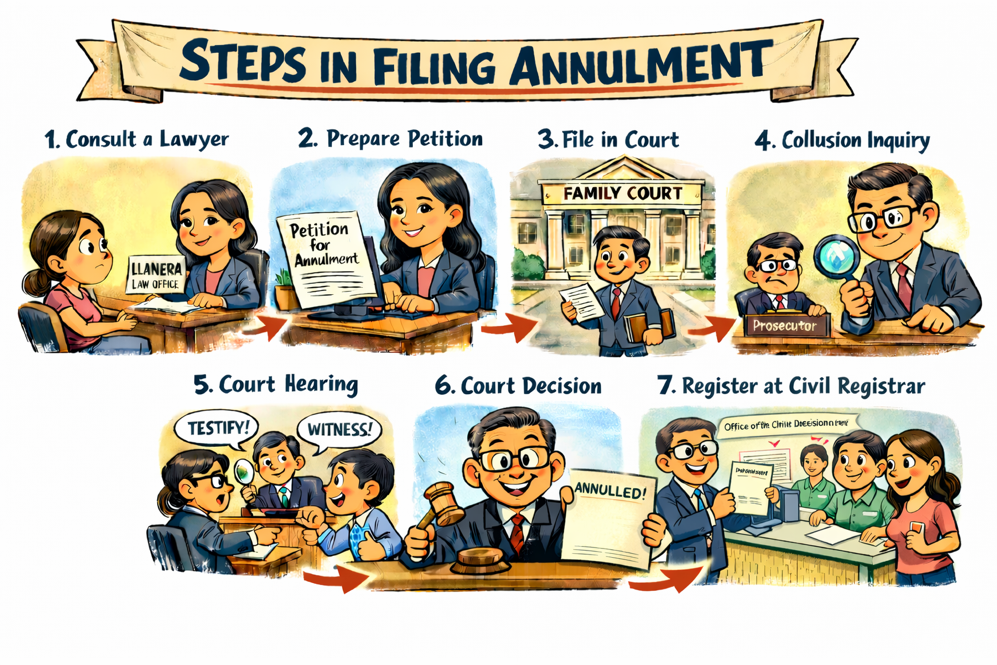
Step-by-Step Guide to Filing Annulment
Step 1: Consult a Lawyer
Engage a competent family lawyer to:
-
- Evaluate your case
-
- Determine the correct legal ground
-
- Assess evidence and strategy
Step 2: Prepare the Petition
Your lawyer will draft a Petition for Annulment of Marriage, which includes:
-
- Personal details of both spouses
-
- Date and place of marriage
-
- Detailed narration of facts
-
- Legal grounds under Article 45 of the Family Code
-
- Supporting evidence
The petition must be verified and signed.
Step 3: File the Case in Court
The petition is filed before the Regional Trial Court (Family Court) of the place where:
-
- You reside; or
-
- Your spouse resides
Step 4: Raffle and Summons
After filing:
-
- The case is raffled to a branch
-
- The court issues summons to the respondent (your spouse)
If the spouse cannot be located, service by publication may be allowed.
Step 5: Collusion Investigation
The court directs the Prosecutor or Solicitor General to determine:
-
- Whether there is collusion between the parties
Annulment cases cannot be based on agreement alone. The State protects marriage.
Step 6: Pre-Trial Proceedings
The court will:
-
- Identify issues
-
- Mark evidence
-
- Require submission of judicial affidavits
Step 7: Trial Proper
During trial:
-
- You (petitioner) testify
-
- Witnesses are presented
-
- Expert testimony (if applicable, e.g., psychological evidence)
The burden of proof lies on the petitioner.
Step 8: Decision of the Court
If the court finds merit, it will issue a Decision granting annulment.
However, the process does not end here.
Step 9: Registration of the Decision
To finalize the annulment:
-
- Obtain a Certificate of Finality
-
- Register the decision with:
-
- Local Civil Registry
-
- Philippine Statistics Authority (PSA)
Without registration, the annulment is not reflected in official records.
How Long Does Annulment Take?
Typical duration is 1 to 3 years, depending on:
-
- Complexity of the case
-
- Court docket congestion
-
- Availability of witnesses
How Much Does Annulment Cost?
Costs vary, but generally include:
-
- Attorney’s fees
-
- Filing fees
-
- Psychological evaluation (if needed)
-
- Publication costs
-
- Properties of spouses to be divided
Each case is unique. A proper legal assessment is necessary for accurate costing.
Important Legal Principles
-
- Marriage is inviolable – Courts strictly scrutinize annulment petitions
-
- Burden of proof – Lies with the petitioner
-
- No shortcut – Mutual agreement is not sufficient
-
- State interest – The government actively opposes weak petitions
Common Mistakes to Avoid
-
- Filing without proper legal ground
-
- Using generic or template petitions
-
- Insufficient evidence
-
- Misidentifying annulment vs nullity
These errors often lead to dismissal of the case.
Why Legal Representation Matters
Annulment is a technical and evidence-driven proceeding. Poorly prepared cases are routinely denied.
Filing an annulment in the Philippines is a structured judicial process grounded in law and evidence. Understanding the steps and legal basis is essential to achieving a successful outcome.
Frequently Asked Questions (FAQs)
1. Can I file annulment without my spouse’s consent?
Yes. Consent is not required. The case proceeds even if the spouse does not participate.
2. Can annulment be denied?
Yes. Courts deny petitions that lack sufficient evidence or legal basis.
3. Can I remarry after annulment?
Yes, but only after the decision becomes final and is properly registered.
4. Is psychological incapacity required?
Not for annulment (Article 45), but it is required for declaration of nullity under Article 36 of the Family Code.
5. Can annulment be processed faster?
There is no guaranteed “fast-track.” However, proper case preparation avoids delays.
Note:
This article is for general informational purposes only and does not constitute legal advice.
If you are considering filing an annulment, it is best to seek proper legal guidance at the earliest opportunity.
For a detailed legal assessment of your situation, you may consult Llanera Law Office. We are committed to providing strategic, professional, and results-oriented legal representation.