
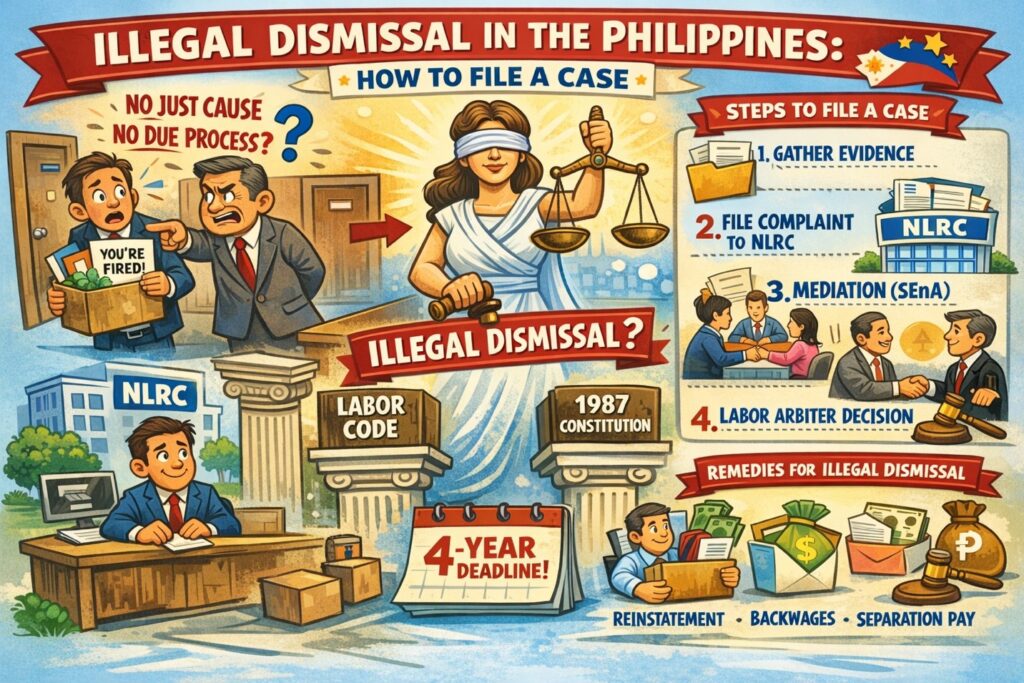
Illegal Dismissal in the Philippines: How to File a Case
A Step-by-Step Guide
Date Published: April 10, 2026
Illegal dismissal is one of the most common labor disputes in the Philippines. Employees who are unjustly terminated have the right to challenge their dismissal and seek reinstatement or compensation. This guide explains what illegal dismissal is, the legal basis, and the step-by-step process for filing a case.
What is Illegal Dismissal?
Illegal dismissal occurs when an employer terminates an employee without just or authorized cause or without due process.
Under Philippine labor law, an employee enjoys security of tenure, meaning they cannot be dismissed unless there is a valid reason and proper procedure is followed.
Legal Basis for Illegal Dismissal
The right against illegal dismissal is grounded in the following laws:
- Labor Code of the Philippines
- Article 294 [formerly Article 279] – Security of tenure
- Articles 297–299 [formerly 282–284] – Just and authorized causes for termination
- 1987 Philippine Constitution (Article XIII, Section 3)
- Guarantees full protection to labor
- Jurisprudence (Supreme Court decisions)
- Establishes the two-notice rule and standards for due process
Valid Grounds for Dismissal
1. Just Causes (Employee Fault)
An employer may dismiss an employee for:
- Serious misconduct
- Willful disobedience
- Gross and habitual neglect of duties
- Fraud or breach of trust
- Commission of a crime against the employer
2. Authorized Causes (Business Reasons)
- Redundancy
- Retrenchment (Article 298)
- Closure or cessation of business
- Installation of labor-saving devices
- Disease (Article 299)
If none of these grounds exist, dismissal may be illegal.
Due Process Requirement (Twin Notice Rule)
Even if there is a valid ground, dismissal becomes illegal if due process is not followed.
Employers must comply with:
- First Notice (Notice to Explain)
- Specifies the charges and gives the employee opportunity to respond
- Opportunity to be Heard
- Hearing or written explanation
- Second Notice (Notice of Decision)
- Final decision stating the reason for dismissal
Failure to comply may result in illegal dismissal or nominal damages.
Signs You May Have Been Illegally Dismissed
- You were terminated without written notice
- No valid reason was explained
- You were forced to resign
- You were dismissed immediately without investigation
- Retrenchment or redundancy was used as a pretext
How to File an Illegal Dismissal Case in the Philippines
Step 1: Gather Evidence
Prepare documents such as:
- Employment contract
- Payslips and company ID
- Termination letter or notice
- Emails, messages, or memos
- Affidavits of witnesses
Step 2: File a Complaint with the NLRC
File your case before the:
- National Labor Relations Commission (NLRC)
- Or the appropriate Labor Arbiter Office
The complaint should include:
- Your personal details
- Employer’s name and address
- Statement of facts
- Reliefs sought (reinstatement, backwages, damages)
Step 3: Mandatory Conciliation-Mediation (SEnA)
Before formal litigation, the case undergoes:
- Single Entry Approach (SEnA) under the Department of Labor and Employment (DOLE)
Purpose:
- Attempt amicable settlement within 30 days
If settlement fails → case proceeds to NLRC.
Step 4: Position Papers Submission
Both parties submit:
- Written arguments
- Supporting evidence
No full-blown trial is required; cases are decided based on pleadings.
Step 5: Decision by Labor Arbiter
The Labor Arbiter will issue a decision based on:
- Evidence presented
- Applicable labor laws
- Jurisprudence
Step 6: Appeal (If Necessary)
- Appeal to NLRC Commission
- Then to the Court of Appeals
- Ultimately to the Supreme Court (via Rule 45)
Remedies for Illegal Dismissal
If the dismissal is declared illegal, the employee is entitled to:
1. Reinstatement
- Return to former position without loss of seniority
2. Backwages
- Salaries from dismissal until reinstatement
3. Separation Pay (if reinstatement not feasible)
- Typically one month salary per year of service
4. Damages and Attorney’s Fees
- Moral and exemplary damages (if bad faith is proven)
Important Deadlines
- Prescriptive period: 4 years from dismissal
- Filing beyond this period may bar your claim
Practical Tips Before Filing
- Do not sign a quitclaim without understanding its consequences
- Document everything immediately after dismissal
- Seek legal advice early to strengthen your case
- Explore settlement if practical
Conclusion
Illegal dismissal cases in the Philippines are governed by well-established laws that protect employees’ rights. Employers must prove both valid cause and due process—failure in either renders the dismissal unlawful. If you believe you were unjustly terminated, acting promptly and following the proper procedure is crucial to securing your rights and remedies.
Need Legal Assistance?
This article is for general informational purposes only and does not constitute legal advice.
If you think you were illegally dismissed, timely legal action is essential.
For a detailed legal assessment of your situation, you may consult Llanera Law Office. We are committed to providing strategic, professional, and results-oriented legal representation.