
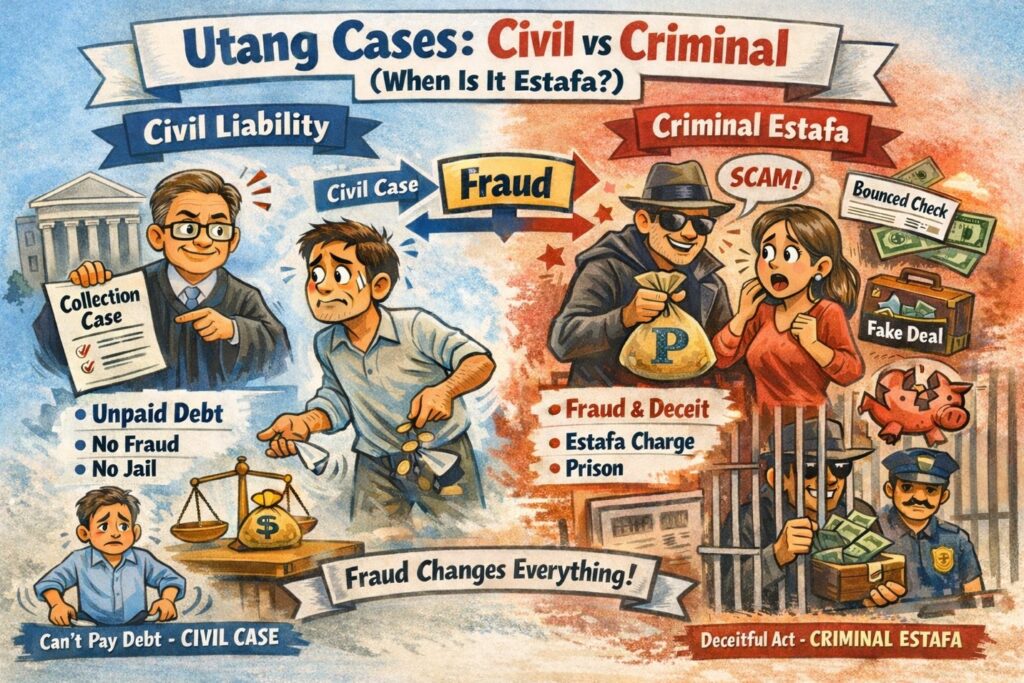
Utang Cases in the Philippines: Civil vs Criminal
(When Does It Become Estafa?)
Date Published: April 09, 2026
In the Philippines, unpaid debts or utang are among the most common legal disputes. However, many people misunderstand whether failure to pay a debt is simply a civil obligation or a criminal offense such as estafa.
This guide explains the difference between civil and criminal liability in utang cases, and most importantly, when non-payment may lead to estafa charges under Philippine law.
Is Non-Payment of Utang a Crime?
As a general rule, failure to pay a debt is NOT a crime.
This principle is firmly established under the 1987 Philippine Constitution, specifically:
Article III, Section 20 – “No person shall be imprisoned for debt.”
This means that utang alone creates civil liability, not criminal liability. The creditor’s remedy is to file a civil case for collection of sum of money, not to send the debtor to jail.
Civil Liability in Utang Cases
A debt becomes a civil case when:
- There is a loan agreement (oral or written)
- Money was borrowed and not paid
- There is no fraud, deceit, or criminal intent
Legal Basis
Under the Civil Code of the Philippines, obligations arise from contracts:
- Article 1157 – Obligations arise from law, contracts, quasi-contracts, acts or omissions punished by law, and quasi-delicts
- Article 1169 – Debtor incurs delay upon demand by the creditor
Remedy
The creditor may file:
- Collection of Sum of Money
- Small Claims Case (if within jurisdictional amount)
✔ Result: The court may order payment, but no imprisonment
When Does Utang Become a Criminal Case? (Estafa Explained)
Utang may give rise to criminal liability when fraud or deceit is present from the beginning.
This falls under estafa under:
Legal Basis
Revised Penal Code – Article 315
Estafa is committed when a person defrauds another through:
- Abuse of confidence
- False pretenses or fraudulent acts
- Misappropriation of money or property
Key Element: Deceit or Fraud
For a debt to become estafa, the prosecution must prove:
- Deceit existed at the time of the transaction
- The victim was induced to part with money
- The offender failed to return or misappropriated the amount
- There was damage or prejudice
⚠️ Without deceit, the case remains purely civil.
Common Situations: Civil vs Estafa
1. Simple Loan (Civil Case Only)
- A borrows money from B
- A fails to pay on due date
✔ Result: Civil liability only
❌ No estafa
2. Bouncing Checks (Possible Criminal Case)
If a debtor issues a check that bounces:
- It may fall under:
- Batas Pambansa Blg. 22
- Or estafa under Article 315(2)(d) if issued with deceit
✔ May result in criminal liability
3. Fraudulent Borrowing (Estafa)
Example:
- Borrower pretends to have a business or project
- Uses false representations to obtain money
- Has no intention to repay
✔ Result: Estafa case may prosper
4. Misappropriation of Money (Estafa)
Example:
- Money is given for a specific purpose (e.g., investment, purchase, safekeeping)
- The recipient uses it for personal benefit
✔ Result: Estafa under Article 315(1)(b)
Important Distinction: Intent Matters
The Supreme Court has consistently ruled:
Failure to pay is not estafa unless there is proof of fraud or deceit at the inception of the transaction.
This distinction is crucial:
| Situation | Liability |
| Cannot pay due to financial difficulty | Civil |
| Refuses to pay despite ability | Civil |
| Obtained money through deception | Criminal (Estafa) |
Can a Case Be Both Civil and Criminal?
Yes.
A single act may give rise to:
- Civil liability – obligation to return money
- Criminal liability – punishment for fraud
Under Philippine law, civil liability is implied in criminal actions.
Practical Tips for Creditors and Debtors
For Creditors
- Secure written agreements or promissory notes
- Keep proof of payments and communications
- File the correct case (civil vs criminal)
For Debtors
- Avoid issuing checks without funds
- Be transparent in transactions
- Document agreements to avoid misunderstandings
Conclusion
Not all unpaid debts in the Philippines lead to criminal cases. As a rule:
- Utang = Civil Liability
- Utang + Fraud/Deceit = Possible Estafa
Understanding this distinction protects both creditors and debtors from misusing the legal system and ensures that cases are filed properly under Philippine law.
Need Legal Assistance?
This article is for general informational purposes only and does not constitute legal advice.
If you are dealing with a debt dispute—whether collection or possible estafa—it is best to consult a lawyer to assess the facts and determine the proper legal remedy.
For a detailed legal assessment of your situation, you may consult Llanera Law Office. We are committed to providing strategic, professional, and results-oriented legal representation.