
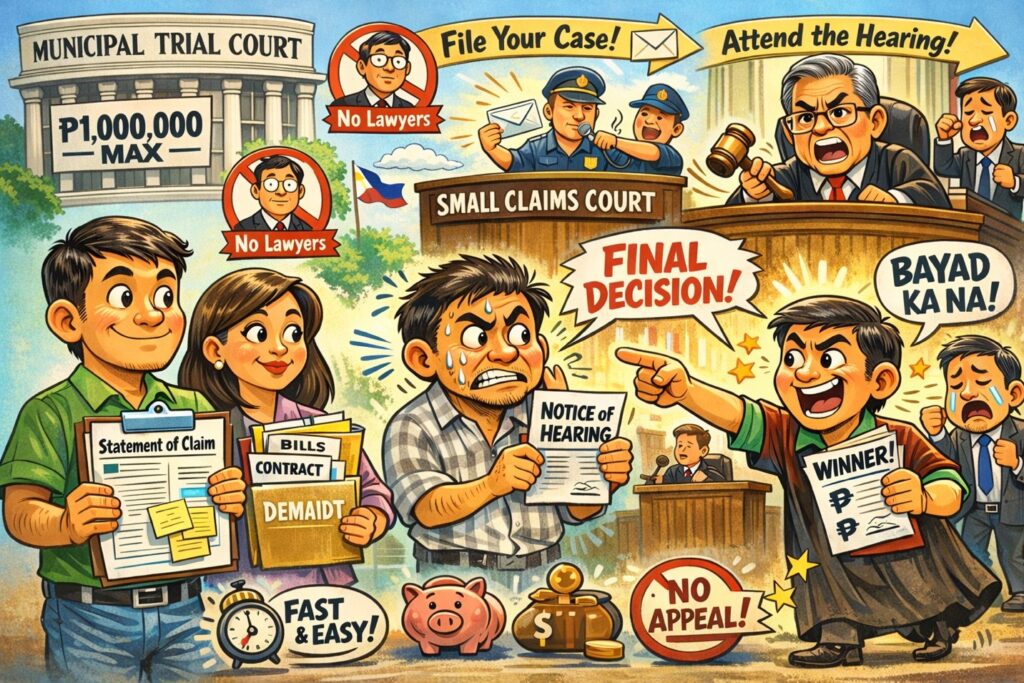
How to File a Small Claims Case in the Philippines
(Complete 2026 Guide)
Date Published: April 15, 2026
If you are trying to recover money without the expense of hiring a lawyer, the small claims procedure in the Philippines is designed exactly for that purpose. It is fast, simplified, and accessible—even for individuals without legal training.
This guide explains how to file a small claims case in the Philippines, including the legal basis, step-by-step process, requirements, and practical tips to help you succeed.
What is a Small Claims Case?
A small claims case is a special civil action for the recovery of money where lawyers are not allowed to appear for parties. The process is simplified to ensure quick resolution—often within a single hearing.
Small claims cases are governed by:
- A.M. No. 08-8-7-SC (as amended)
- 2019 Amendments to the 2016 Revised Rules on Small Claims Cases
These rules were issued by the Supreme Court of the Philippines to provide a speedy and inexpensive remedy for monetary disputes.
What Cases Are Covered?
You may file a small claims case if your claim involves purely monetary obligations, such as:
- Unpaid loans or utang
- Bounced or dishonored checks (BP 22-related civil liability)
- Unpaid credit card balances
- Rent arrears or damages
- Services rendered but unpaid
- Enforcement of barangay settlement involving money
Jurisdictional Amount: As of current rules, the maximum claim is ₱1,000,000, exclusive of interest and costs.
Where to File a Small Claims Case?
File your case before the first-level courts, such as:
- Metropolitan Trial Court (MeTC)
- Municipal Trial Court in Cities (MTCC)
- Municipal Trial Court (MTC)
- Municipal Circuit Trial Court (MCTC)
Venue is typically based on the residence of the plaintiff or defendant, at your option.
Step-by-Step Guide: How to File a Small Claims Case
1. Prepare the Statement of Claim
You must fill out the official Statement of Claim (Form 1-SCC). This form contains:
- Your personal details (plaintiff)
- Defendant’s details
- Amount being claimed
- Brief facts of the case
Attach all supporting documents, such as:
- Promissory notes
- Receipts or invoices
- Contracts or agreements
- Demand letters
2. Execute a Verification and Certification
You must certify under oath that:
- Your claim is true and correct
- There is no forum shopping
This is usually included in the form itself.
3. File the Case in Court
Submit your documents to the proper court and pay the filing fees. Fees depend on the amount of your claim but are generally minimal compared to regular civil cases.
4. Wait for the Notice of Hearing
The court will issue a Notice of Hearing, typically scheduled within a short period. The defendant will also be served a copy of your claim.
5. Attend the Hearing (Mandatory)
This is the most crucial stage.
- Lawyers are not allowed to represent parties (except in very limited instances)
- The judge will conduct a summary hearing
- You will personally explain your claim and present your evidence
Expect the hearing to be informal but direct. The judge may ask clarificatory questions.
6. Receive the Decision
After the hearing, the court will render a decision within 24 hours.
Important:
- The decision is final and unappealable
- No motions for reconsideration are allowed
This ensures speedy justice.
Do You Need a Lawyer?
Generally, no. The rules prohibit lawyer participation to:
- Reduce costs
- Simplify proceedings
- Encourage direct participation
However, you may still consult a lawyer beforehand for guidance in preparing your documents.
Key Advantages of Small Claims Cases
- Fast resolution (often within weeks)
- Low cost
- No need for a lawyer
- Simple procedure
- Immediate enforceability of judgment
Practical Tips for Success
- Organize your documents clearly – judges rely heavily on written proof
- Be concise and factual – avoid unnecessary narratives
- Bring originals and photocopies
- Practice your explanation – clarity matters
- Ensure proper demand was made before filing
Frequently Asked Questions (FAQs)
Can I appeal a small claims decision?
No. Decisions are final, executory, and unappealable under the rules.
What happens if the defendant does not appear?
The court may proceed ex parte and decide based on your evidence.
Can corporations file small claims?
Yes, but they must be represented by an authorized officer—not a lawyer.
Conclusion
Filing a small claims case in the Philippines is one of the most efficient ways to recover money without undergoing lengthy litigation. With clear documentation and proper preparation, you can obtain a binding judgment in a matter of weeks.
If you need assistance in preparing your claim or evaluating your case, consulting a legal professional can still provide a strategic advantage—even if they won’t appear in court.
Note:
This article is for general informational purposes only and does not constitute legal advice.
If you are considering filing a case, it is best to seek proper legal guidance at the earliest opportunity.
For a detailed legal assessment of your situation, you may consult Llanera Law Office. We are committed to providing strategic, professional, and results-oriented legal representation.