
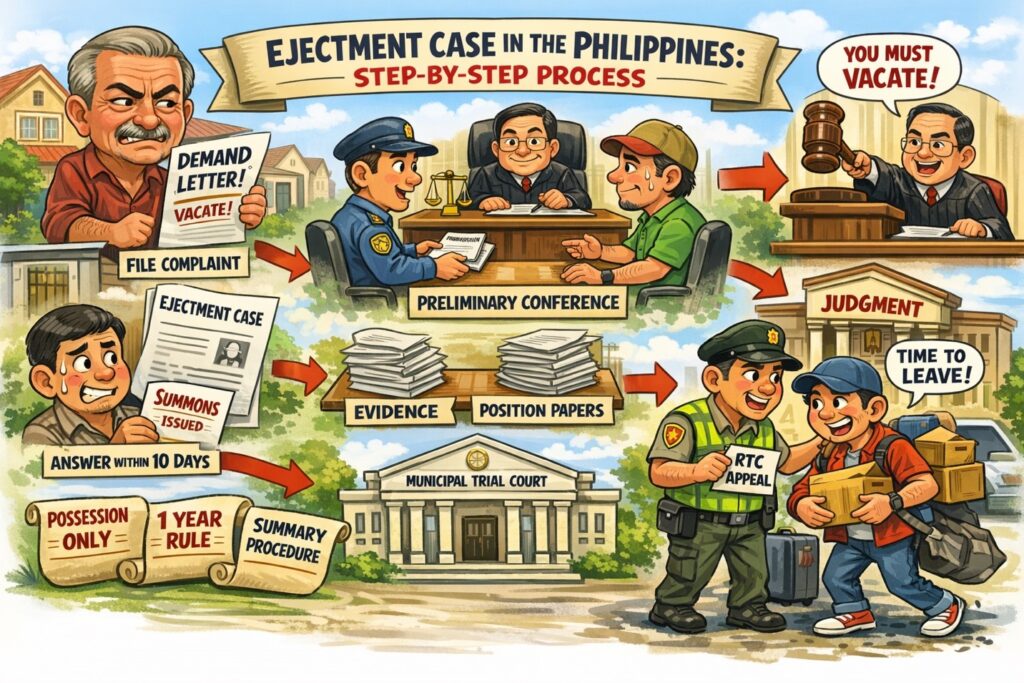
Ejectment Case in the Philippines: Step-by-Step Process
Date Published: April 16, 2026
An ejectment case is one of the most commonly filed actions in Philippine courts, particularly involving disputes over possession of property. Whether you are a landlord dealing with a non-paying tenant or an owner seeking to recover possession from an unlawful occupant, understanding the legal process is crucial.
This guide provides a clear and legally grounded explanation of ejectment cases in the Philippines, including the step-by-step procedure under the Rules of Court.
What Is an Ejectment Case?
An ejectment case is a summary judicial proceeding designed to recover physical possession (possession de facto) of real property. It does not determine ownership, except provisionally.
There are two types:
- Forcible Entry (Rule 70, Section 1)
- Possession was obtained through force, intimidation, threat, strategy, or stealth
- Unlawful Detainer (Rule 70, Section 1)
- Possession was initially lawful (e.g., lease), but became illegal after the expiration or termination of the right to possess
📌 Legal Basis: Rule 70 of the Rules of Court; jurisprudence from the Supreme Court of the Philippines consistently affirms that ejectment cases involve possession only.
Who Has Jurisdiction?
Ejectment cases fall under the exclusive original jurisdiction of:
- Municipal Trial Courts (MTC)
- Metropolitan Trial Courts (MeTC)
- Municipal Circuit Trial Courts (MCTC)
📌 Legal Basis: Batas Pambansa Blg. 129 (Judiciary Reorganization Act), as amended
Step-by-Step Process of Filing an Ejectment Case
1. Send a Demand Letter (Mandatory in Unlawful Detainer)
Before filing, the plaintiff must send a written demand to vacate and/or pay.
- Required in unlawful detainer
- Not strictly required in forcible entry, but still recommended
📌 The demand must clearly:
- Require the defendant to vacate the property
- Provide a reasonable period to comply
📌 Legal Basis: Rule 70, Section 2
2. File the Complaint in Court
The complaint must include:
- Allegation of prior possession
- How possession was unlawfully withheld
- Compliance with demand requirement (for unlawful detainer)
- Prayer for:
- Restitution of possession
- Payment of rentals or reasonable compensation (damages)
📌 Important: The case must be filed within one (1) year from:
- Date of dispossession (forcible entry), or
- Last demand to vacate (unlawful detainer)
📌 Legal Basis: Rule 70, Section 1
3. Issuance of Summons
Once filed, the court issues summons requiring the defendant to file an answer.
4. Filing of Answer (Within 10 Days)
The defendant must file an Answer within ten (10) days from service of summons.
Failure to file may result in:
- Judgment based on plaintiff’s evidence
📌 Legal Basis: Rule 70, Section 6
5. Preliminary Conference
The court will schedule a preliminary conference to:
- Explore settlement
- Define issues
- Mark evidence
Non-appearance may result in:
- Dismissal (if plaintiff absent)
- Judgment against defendant (if absent)
📌 Legal Basis: Rule 70, Section 8
6. Submission of Position Papers
Instead of a full trial, parties submit:
- Affidavits
- Documentary evidence
- Position papers
This reflects the summary nature of ejectment cases.
📌 Legal Basis: Rule 70, Section 10
7. Judgment (Within 30 Days)
The court must render judgment within 30 days after submission.
Possible rulings include:
- Restoration of possession to plaintiff
- Payment of unpaid rent or damages
- Attorney’s fees and costs
📌 Legal Basis: Rule 70, Section 11
8. Execution of Judgment
Judgment is immediately executory, even if appealed.
To stay execution, defendant must:
- Perfect an appeal
- File a supersedeas bond
- Continue paying rent during appeal
📌 Legal Basis: Rule 70, Section 19
9. Appeal (Optional)
Appeal may be filed to the Regional Trial Court (RTC), but:
- Only questions of fact and law may be raised
- Execution generally proceeds unless stayed
Key Legal Principles in Ejectment Cases
1. Possession vs Ownership
The court decides who has the better right to possess, not ownership.
2. One-Year Rule
Strict compliance is required. Filing beyond one year may convert the case into an accion publiciana or accion reivindicatoria.
3. Summary Procedure
Ejectment cases are designed to be fast and efficient, avoiding prolonged litigation.
📌 Legal Basis: Revised Rules on Summary Procedure
Practical Tips Before Filing
- Always document your demand letter
- Keep records of leases, payments, or agreements
- Act quickly to avoid missing the one-year prescriptive period
- Ensure proper allegations in the complaint—technical defects can be fatal
Need Legal Assistance?
This article is for general informational purposes only and does not constitute legal advice.
If you are dealing with a tenant who refuses to vacate or an occupant unlawfully withholding your property, timely legal action is essential.
For a detailed legal assessment of your situation, you may consult Llanera Law Office. We are committed to providing strategic, professional, and results-oriented legal representation.