
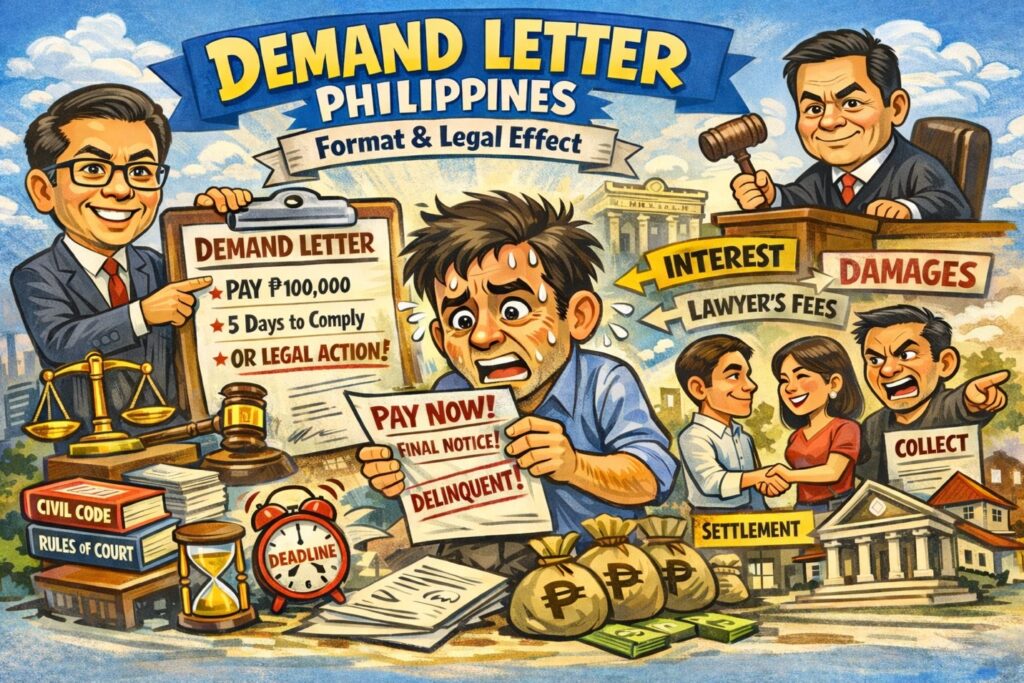
Demand Letter Philippines: Format and Legal Effect
Date Published: April 17, 2026
A demand letter is often the first decisive step before filing a case in the Philippines. Whether you are dealing with unpaid debts, breach of contract, property disputes, or damages, a properly drafted demand letter can significantly affect the outcome of your legal claim.
This guide explains the format, legal basis, and legal effect of a demand letter under Philippine law.
What is a Demand Letter?
A demand letter is a formal written communication sent by one party (the creditor or claimant) to another (the debtor or respondent), requiring compliance with an obligation within a specified period.
It typically demands:
- Payment of a debt
- Performance of an obligation
- Delivery of property
- Cessation of a wrongful act
In legal practice, it serves as proof that the claimant has made a prior demand, which is often required before filing a case.
Legal Basis of a Demand Letter in the Philippines
The importance of a demand letter is grounded in the Civil Code of the Philippines, particularly:
1. Article 1169, Civil Code
“Those obliged to deliver or to do something incur in delay from the time the obligee judicially or extrajudicially demands from them the fulfillment of their obligation.”
🔎 Key implication:
A debtor is generally not in delay (mora) unless a demand—either judicial or extrajudicial—is made.
2. Article 2209, Civil Code
Interest for damages may be recovered in obligations involving payment of money when the debtor is in delay.
🔎 Effect:
A demand letter triggers entitlement to:
- Legal interest
- Damages
3. Rules of Court (Small Claims & Civil Cases)
Demand letters are often required or strongly recommended before filing:
- Small Claims Cases (A.M. No. 08-8-7-SC, as amended) – Demand letter may serve as supporting evidence
- Collection cases – To prove cause of action
- Ejectment cases – Demand to vacate is mandatory
When is a Demand Letter Required?
A demand letter is legally necessary in the following situations:
1. When the law requires prior demand
Examples:
- Ejectment cases (unlawful detainer) – demand to vacate is essential
- Collection of sum of money – to establish delay
2. When the contract requires it
Some agreements include clauses requiring formal demand before enforcement
3. When delay must be established
To claim:
- Interest
- Damages
- Attorney’s fees
Exceptions: When Demand is Not Required
Under Article 1169, demand is not necessary when:
- The obligation or law expressly states otherwise
- Time is of the essence (e.g., delivery on a specific date)
- Demand would be useless (e.g., debtor already refused performance)
Standard Format of a Demand Letter (Philippines)
A well-drafted demand letter should follow a structured legal format:
1. Heading
- Name and address of sender
- Date
- Name and address of recipient
2. Subject Line
Example:
RE: Demand for Payment of ₱100,000.00
3. Opening Statement
Clearly state the relationship and obligation:
“This refers to your outstanding obligation arising from…”
4. Statement of Facts
- Brief background of the transaction
- Dates, agreements, and violations
5. Demand Proper
Specify:
- What is required (payment, action, etc.)
- Exact amount or obligation
- Deadline (e.g., 5–15 days)
6. Legal Warning
Indicate consequences:
“Failure to comply will constrain us to take appropriate legal action…”
7. Closing
- Formal closing
- Name and signature (preferably counsel)
Legal Effect of a Demand Letter
A demand letter has several important legal consequences:
1. Places the Debtor in Delay (Mora)
Once received, the debtor becomes legally liable for:
- Interest
- Damages
2. Strengthens Your Case in Court
It shows:
- Good faith effort to settle
- Existence of a valid claim
- Compliance with legal requirements
3. Basis for Award of Damages and Attorney’s Fees
Courts may award:
- Moral or actual damages
- Attorney’s fees (Article 2208, Civil Code)
4. May Lead to Settlement
Many disputes are resolved without litigation once a formal demand is made.
Practical Tips in Drafting a Demand Letter
To maximize effectiveness:
- ✔ Be clear, concise, and factual
- ✔ Avoid emotional or threatening language
- ✔ State exact amounts and deadlines
- ✔ Attach supporting documents (if applicable)
- ✔ Send via registered mail or courier with proof of receipt
Common Mistakes to Avoid
- ❌ No clear deadline
- ❌ Vague or unsupported claims
- ❌ No proof of service
- ❌ Overly aggressive tone
- ❌ Failure to cite basis of obligation
Conclusion
A demand letter is more than a formality—it is a critical legal tool in Philippine practice. It establishes delay, preserves your rights, and often determines whether a case will succeed in court or be settled amicably.
For best results, a demand letter should be strategically drafted, legally grounded, and properly served.
Frequently Asked Questions (FAQ)
1. Is a demand letter required before filing a case in the Philippines?
Not always, but it is generally required to establish delay and is mandatory in certain cases like ejectment.
2. How many days should be given in a demand letter?
Typically 5 to 15 days, depending on the nature of the obligation.
3. Can I file a case without a demand letter?
Yes, in some cases, but your claim for damages or interest may be weakened.
4. Is a demand letter legally binding?
It is not a court order, but it has legal effects, especially in placing the debtor in delay.
5. Who should sign the demand letter?
It may be signed by the claimant, but it is more effective when issued by a lawyer.
Need Assistance?
This article is for general informational purposes only and does not constitute legal advice.
If you are considering sending a demand letter or you have received a demand letter, it is best to seek proper legal guidance at the earliest opportunity.
For a detailed legal assessment of your situation, you may consult Llanera Law Office. We are committed to providing strategic, professional, and results-oriented legal representation.